![Magyarbusz [Info]](/mbi/header-logo.png)
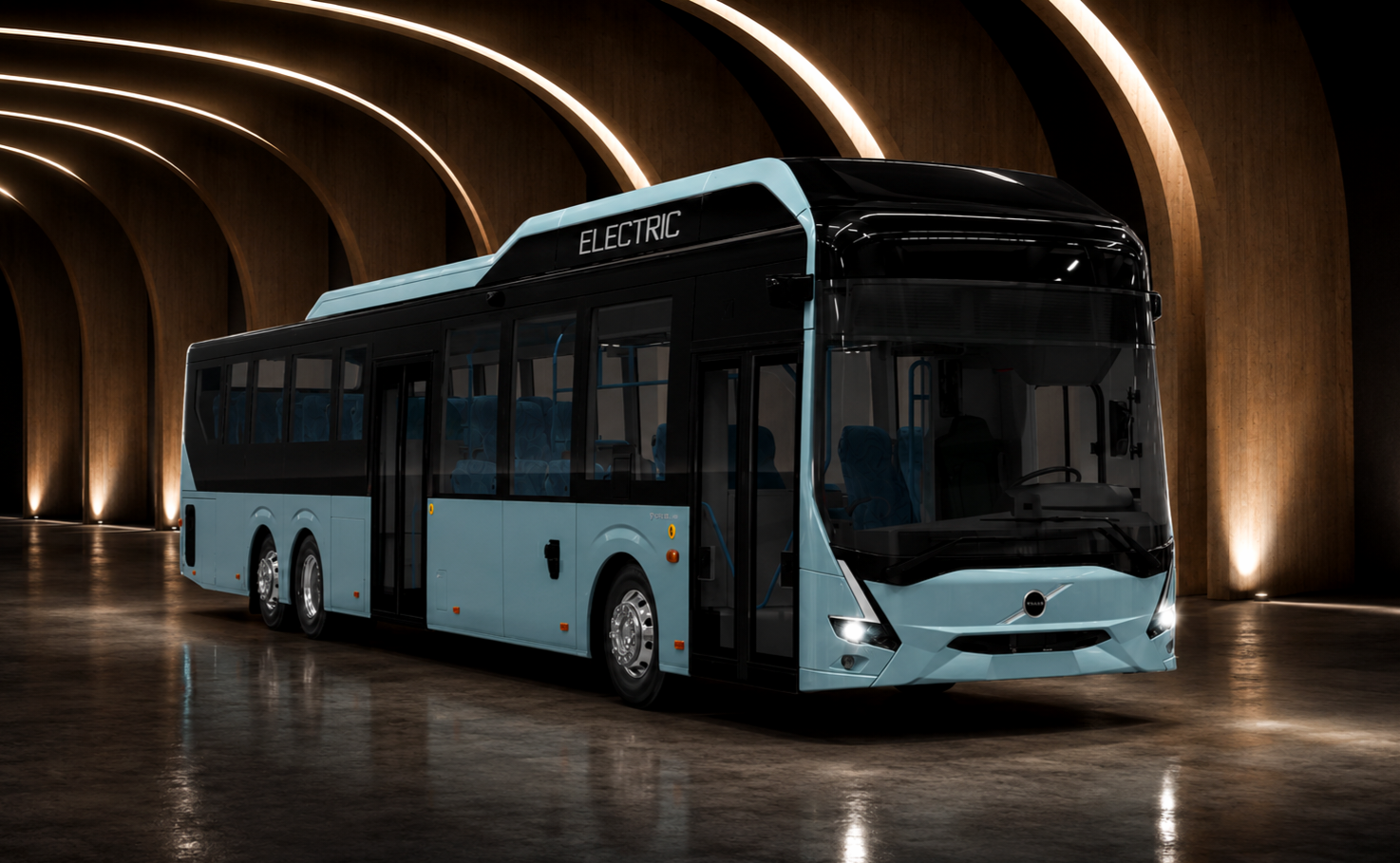
Volvo 8900 Electric: electric drive, unchanged passenger capacity
 Ludányi József
It is now more than two years since Volvo Buses fundamentally restructured its European bus manufacturing operations; the Swedish manufacturer announced in 2023 that it would discontinue the production of complete buses in Europe and would in future focus primarily on the development of chassis, driveline systems and electromobility solutions. The decision also saw several well-known models disappear from the European market: some were removed from the portfolio only temporarily, while others said goodbye to the continent for good. The latter included the diesel-powered version of the Volvo 8900 family, several of whose final examples found a home in the Volánbusz fleet. The model, however, did not disappear completely, as Volvo has revived the type with an electric driveline, and it is now offered as the Volvo 8900 Electric. The new generation, however, has been born in a completely different industrial environment: the vehicles are built at the Egyptian production base of MCV, as part of Volvo Buses’ new partnership and contract-manufacturing strategy.
Although the name MCV is by no means unknown in the bus industry, there are still some in parts of the European market who react with reservations to the company’s products when they hear that production takes place in Egypt. These prejudices, however, typically stem more from the manufacturer’s geographical location than from the company’s actual market performance. MCV has, after all, been present on the international bus market for decades and is one of Volvo’s important strategic partners, while vehicles built by the company operate in the fleets of numerous major operators in the United Kingdom.
In the case of the Volvo 8900 Electric, however, we are not talking about an independent MCV product. Development of the type continues to be managed by Volvo Buses, with the Swedish manufacturer defining the basic concept, the main technical solutions, the driveline and the choice of components. Volvo is also responsible for sales, homologation, and the provision of the service and spare-parts support network for the type.
Since the 8900 Electric’s primary target market remains Europe, the manufacturing process must fully comply with EU type-approval and quality-assurance requirements. To this end, Volvo engineers provide continuous professional support to the Egyptian plant, take part in setting up the production processes and regularly audit the operation of the quality-assurance systems. Production may therefore take place outside Europe geographically, but the vehicles are built according to the technical, quality and safety requirements defined by Volvo. The chassis is still manufactured in Borås, Sweden, while the powertrain is supplied by Volvo Powertrain’s plant in Köping. In addition, many of the vehicle’s key components come from the same supplier base that previously served Volvo’s European-built buses.

A three-axle Volvo 8900 built at Volvo’s former plant in Wrocław, Poland
As for the vehicle itself, with the new Volvo 8900 Electric the manufacturer deliberately sought to preserve the most important characteristics of its predecessor. The body essentially carries forward the design and structural heritage of the earlier Volvo 8900 family, meaning the new model remains instantly recognisable at first glance. Although the model is now based on Volvo’s new-generation BZR Electric platform, many elements of its design can be traced back to the earlier Volvo B8RLE chassis versions. The Swedish manufacturer’s engineers did not start developing a new interurban electric bus from scratch; instead, they built on the proven solutions of the previous design. Accordingly, many of the vehicle’s running-gear and structural elements, as well as its heavy-duty suspension system, draw on the experience of the earlier generation, while the driveline is now entirely electric.

Interestingly, Volvo first introduced the three-axle version with a 6×2 driveline configuration to the market. This can hardly be considered a random decision, as the number of axles plays a particularly important role in the case of electric interurban buses. While the maximum permissible gross vehicle weight of a two-axle electric bus is currently 19.5 tonnes, the same figure for a three-axle version can be as high as 28 tonnes. The basis for this is that the weight limit for three-axle solo buses of up to 15 metres in length is generally 26 tonnes, which may be increased by up to a further 2 tonnes for types equipped with alternative drivelines – such as battery-electric or hydrogen-powered systems – if justified by the vehicle’s type-approval documentation.
Although the third axle and the longer body increase the vehicle’s unladen weight in themselves, the configuration nevertheless gives manufacturers far more room for manoeuvre. The available weight reserve can be used to install a larger battery pack, increase passenger capacity or even improve range, making it easier for operators to find the right balance between vehicle weight, capacity and energy supply. It is therefore no coincidence that in recent years several manufacturers have unveiled their first electric interurban buses in a three-axle configuration.

In the case of the Volvo 8900 Electric, the 14.9-metre-long, three-axle version has a maximum permissible gross vehicle weight of 27 tonnes, while its unladen weight with the largest battery capacity is around 18.7 tonnes; Volvo has therefore not made full use of the weight reserve provided by the regulations. Several factors may lie behind this, including the vehicle’s structural design, axle-load limitations, and the load-bearing capacity of the axles and suspension systems used. In practice, however, a 27-tonne gross weight still provides considerable flexibility for the batteries, passengers and other on-board equipment.
In light of the figures above, and after a little calculation, it is clear that Volvo’s engineers have succeeded in avoiding one of the most common compromises associated with electric buses. Even when equipped with the largest, 540 kWh battery pack, the 8900 Electric suffers no meaningful loss of capacity compared with the diesel version.

The three-axle diesel version of the Volvo 8900 LE has an unladen weight of around 15,000 kilograms and a maximum permissible gross vehicle weight of 24,750 kilograms, while being capable of carrying up to 110 passengers. In this case, capacity is determined not by the available payload, but by the passenger-compartment layout resulting from the M3/Class II configuration, as well as by the regulations governing the number and size of standing spaces. Based on the vehicle’s payload capacity, it would be possible to carry significantly more passengers – even around 130 – but the rules applicable to the M3/Class II category do not allow the number of standing places to be increased to this extent.
For the electric version, the situation has essentially remained unchanged. With a maximum permissible gross vehicle weight of 27 tonnes and a payload capacity of more than 8 tonnes, the vehicle does not run into weight-related limitations; capacity continues to be governed by the requirements of the M3/Class II category. Based on the type’s payload, it would be possible to carry somewhat more passengers, but the category rules and the interior layout once again cap capacity at 110 people. As a result, even with the installation of a battery pack of up to 540 kWh, the nominal passenger capacity of the diesel version has been retained – something that is still far from self-evident in the market for electric interurban buses today. Volvo’s developers therefore did not aim to install the largest possible battery capacity, but to create a balanced design. Part of the available weight reserve was indeed devoted to substantial energy-storage capacity, but the same passenger capacity and payload as in the diesel version were also successfully preserved.

The three-axle model is driven by Volvo’s in-house-developed EPT802 electric driveline. The system consists of two electric motors delivering a combined continuous output of 334 kW and a peak output of 400 kW. In designing the driveline, Volvo used a so-called T-drive layout, the essence of which is that the electric motors are positioned behind the driven axle, on its centreline. For greater energy efficiency, the torque produced by the electric motors is not transmitted directly to the driven axle, but via a two-speed automated Volvo I-Shift gearbox. Although most electric buses now use a single-speed reduction gear, Volvo continues to adhere to a multi-speed transmission because of the specific requirements of interurban operation. As a result, the driveline can provide greater tractive effort at lower speeds and more favourable energy consumption in highway operation. The system’s maximum wheel torque reaches 31,000 Nm.
Energy supply is provided by Volvo’s modular battery system. The largest configuration currently available consists of six lithium-ion batteries, each with an energy-storage capacity of 90 kWh. This gives a total installed capacity of 540 kWh. The batteries, based on NCA (lithium nickel cobalt aluminium oxide) cell chemistry, are built using Samsung SDI 21700 cells. One of the technology’s most important advantages is its high energy density, allowing the vehicle to store a substantial amount of energy at a relatively low weight. Three of the six battery modules are mounted on the roof, while Volvo has placed the remaining three units in the former engine compartment, making use of the installation space freed up by the removal of the diesel version’s driveline.

The battery modules weigh 504 kilograms each, meaning the six-unit battery pack has a total weight of more than three tonnes. The energy-storage system alone accounts for nearly one sixth of the vehicle’s unladen weight; however, together with the electric motors, power electronics, cooling systems and other high-voltage equipment connected to the batteries, the mass of the electric driveline can reach almost one third of the vehicle’s total weight. This clearly illustrates why a three-axle configuration is so important for electric interurban buses of this size.

According to Volvo’s data, the version equipped with the largest battery pack has an energy consumption of 1.15 kWh per kilometre, or 1.265 kWh/km when charging losses are also taken into account. The figure was determined according to the internationally accepted SORT 2 cycle, at an average speed of 18 km/h, an outside temperature of 18 degrees Celsius and with maximum passenger load. According to the manufacturer’s calculations, the batteries will not need to be replaced over the vehicle’s entire planned service life of 800,000 kilometres.
All this inevitably also raises the question of how environmentally friendly a nearly 15-metre-long electric bus equipped with a battery system weighing more than three tonnes can really be considered. The answer is by no means black and white. The undeniable advantage of electric drive is that the vehicle produces no local harmful emissions during operation, while the production of the batteries requires significant raw-material and energy input. At the same time, life-cycle analyses of electric buses consistently find that the overwhelming majority of total environmental impact arises not during the manufacturing phase, but over several hundred thousand kilometres of operation. In the case of a modern electric bus, manufacturing typically accounts for a smaller share of the environmental burden over the full life cycle, while the decisive proportion is determined by energy consumption and by how the electricity used in operation is generated.

In the case of the Volvo 8900 Electric, however, it is an interesting point that the manufacturer did not seek to install the largest possible battery pack, but to create a design that attempts to strike a balance between the size of the energy-storage system, the vehicle’s weight and passenger capacity. Despite the still sizeable battery system, the same capacity as the diesel version has been retained, meaning the electric driveline has not brought a meaningful reduction in passenger-carrying capability. This is important because the environmental burden associated with manufacturing and operation is thus spread across a larger number of passenger-kilometres, which may result in more favourable specific environmental indicators over the vehicle’s full life cycle.
The images are for illustration purposes.