![Magyarbusz [Info]](/mbi/header-logo.png)
Irizar unveils its second-generation hydrogen-powered coach
 Ludányi József
Irizar’s hydrogen-powered coach development programme has reached another important milestone, as the Spanish manufacturer has unveiled the second-generation version of the vehicle, now built into the body of a three-axle Irizar i6S Efficient. The new development is already closer to a future series-production version than the first two-axle prototype presented at Busworld Europe at the end of 2023, which primarily served to demonstrate the viability of the hydrogen-powered driveline. In the case of the new version, the focus has now shifted to creating a high-capacity coach suitable for long-distance operation and aligned with real market requirements.
The new generation made its debut at the annual general meeting of SHYNE (Spanish Hydrogen Network). According to information from Irizar, the vehicle has already successfully completed its type-approval tests, and testing under real operating conditions will begin in the coming months. Spanish transport company Alsa will take part in the demonstration operation, putting the vehicle into service in the Madrid area during the summer period. It is worth noting that, according to earlier comments by the company’s management, Irizar sees the future of hydrogen propulsion much more in long-distance transport than in urban traffic, so it is no coincidence that its developments in this field are focused on the coach segment, while its urban models are available exclusively with battery-electric drivetrains.
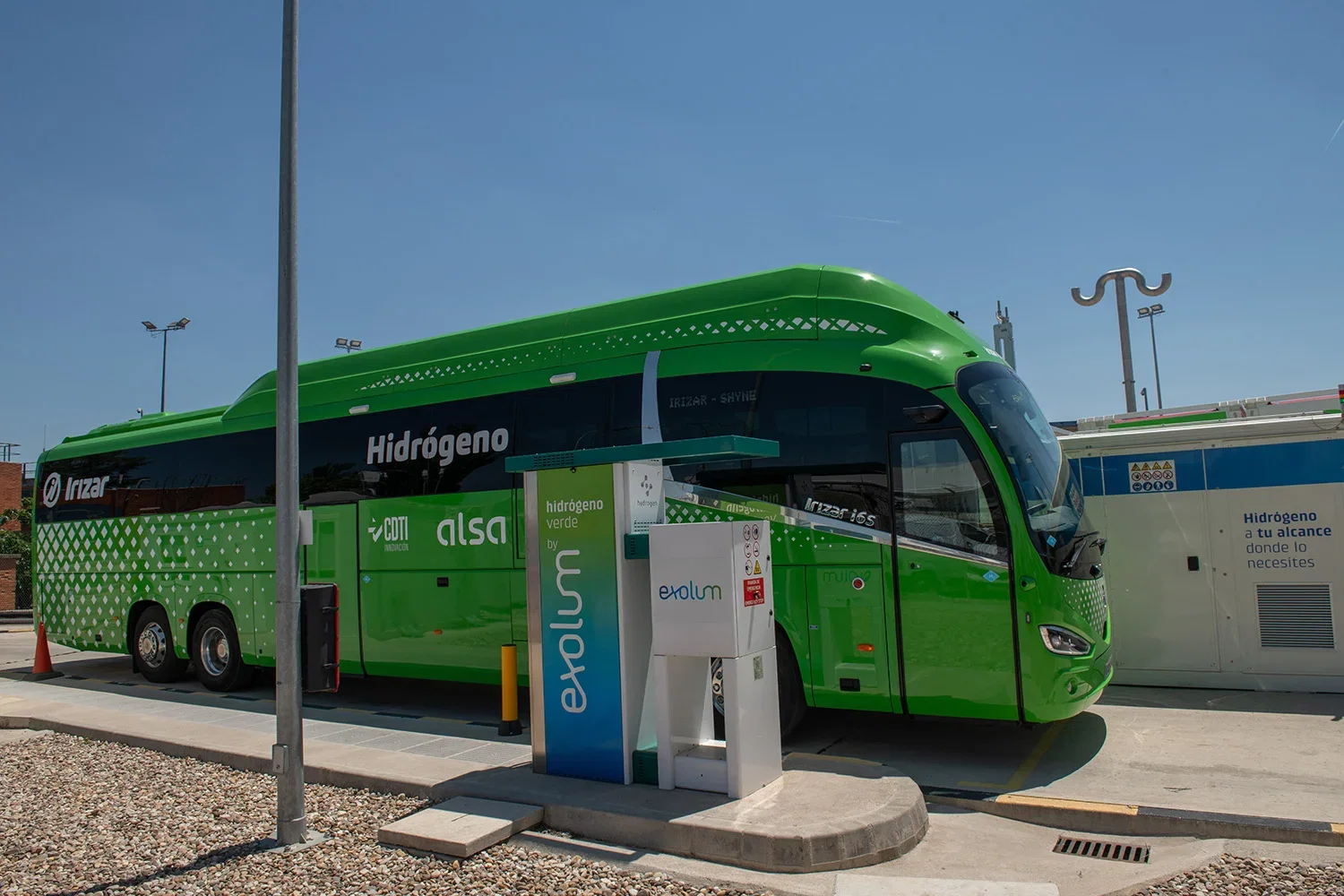
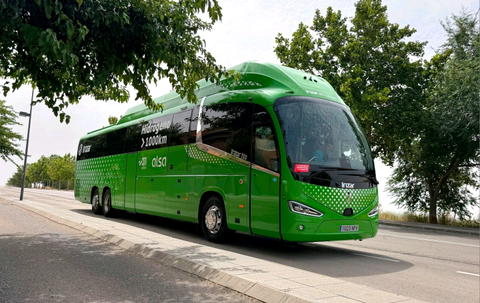
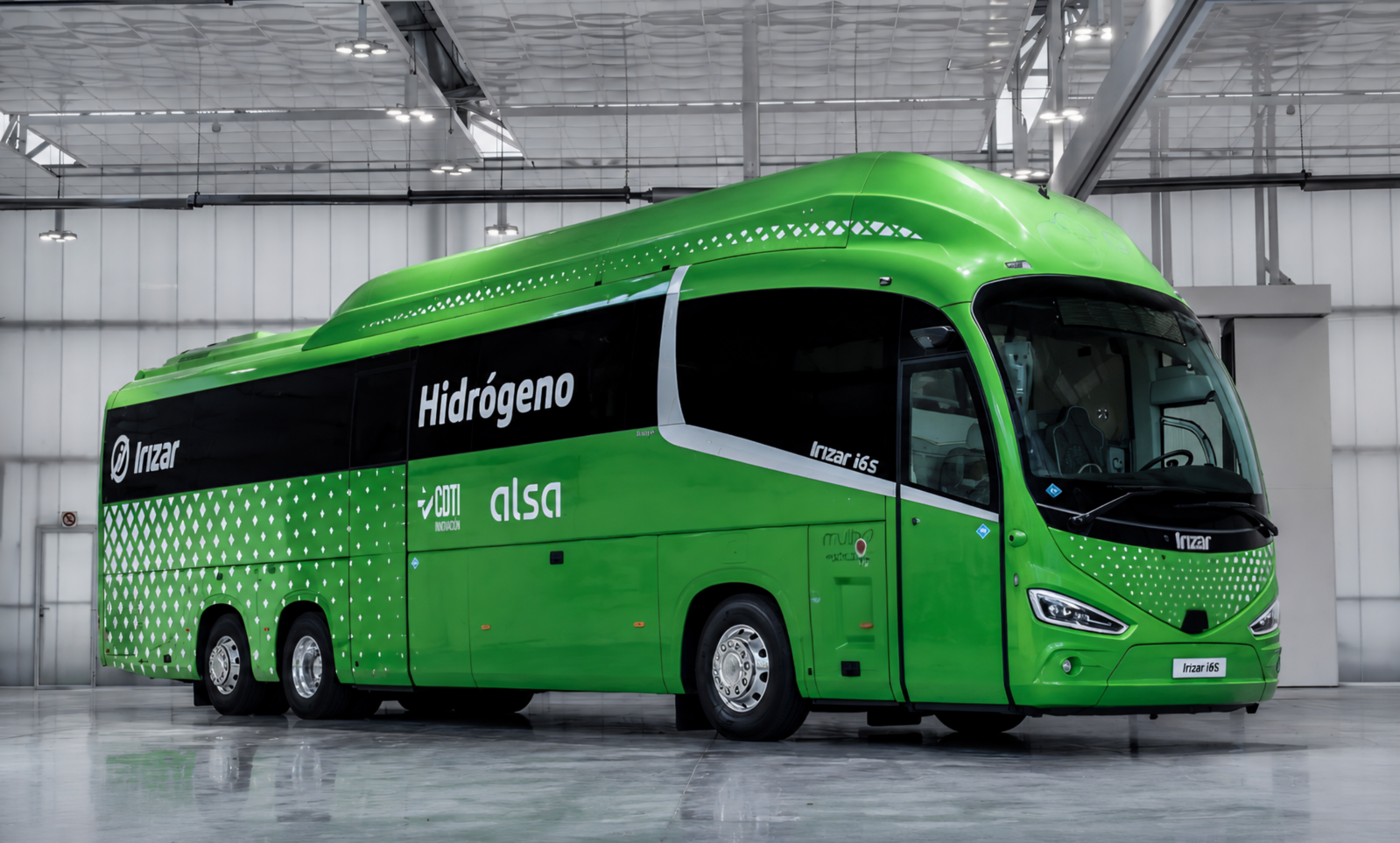
The first example of Irizar’s further-developed hydrogen bus in the colours of transport company Alsa
According to the Spanish manufacturer, the new version of the Irizar i6S Efficient Hydrogen represents progress over the first generation in a number of areas. The first experimental vehicle primarily served to prove the operability of the technology, something demonstrated by several eye-catching tests. The best known of these was the roughly 2,500-kilometre journey completed by the vehicle between Irizar’s headquarters in the Basque Country and Briançon in the French Alps. According to the manufacturer, this was at the time the longest journey ever made in Europe by a hydrogen-powered bus. As a result of the latest developments, passenger capacity and luggage compartment volume have increased, while the vehicle’s unladen weight has also been reduced. The manufacturer has also reported improvements in energy efficiency and a further increase in range.
One important aim of the development was to further reduce the estimated weight difference of around two tonnes between the hydrogen- and diesel-powered versions. Irizar previously stated that, in the longer term, it would like to cut this difference by a further 0.5-1 tonne, potentially reducing the gap between the two drivetrains to around 1-1.5 tonnes. However, the manufacturer has not disclosed how much of this target has been achieved in the second-generation version now presented.
As part of the redesign of the vehicle architecture, the placement of the batteries was also reconsidered. During development, the engineers sought to make the most efficient possible use of the space available between the A and B axles in order to provide operators with the largest possible usable luggage compartment, a particularly important consideration in long-distance and touring applications.
The vehicle’s driveline continues to be based on a hydrogen fuel cell and electric drive. Irizar claims that the coach is now capable of covering more than 1,000 kilometres on a single fill, while refuelling the hydrogen tanks takes around ten minutes. The developers have positioned the hydrogen tanks on the roof, and this layout will also be retained for later series-production versions. As a result, the passenger compartment layout and luggage compartment capacity are practically the same as on Irizar i6S Efficient models fitted with a conventional powertrain, meaning the installation of the hydrogen drive entails no significant compromises in terms of passenger and luggage capacity.
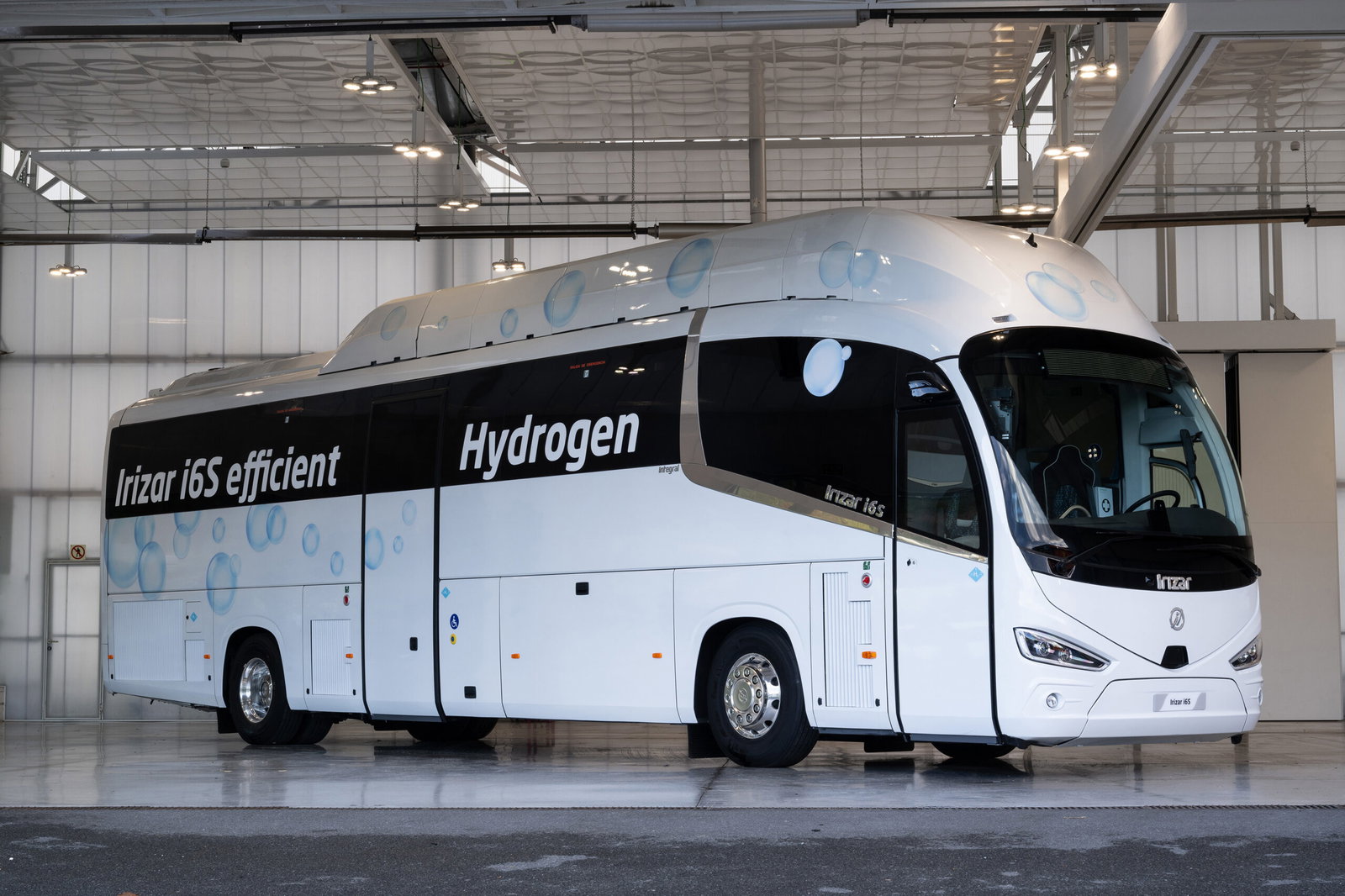
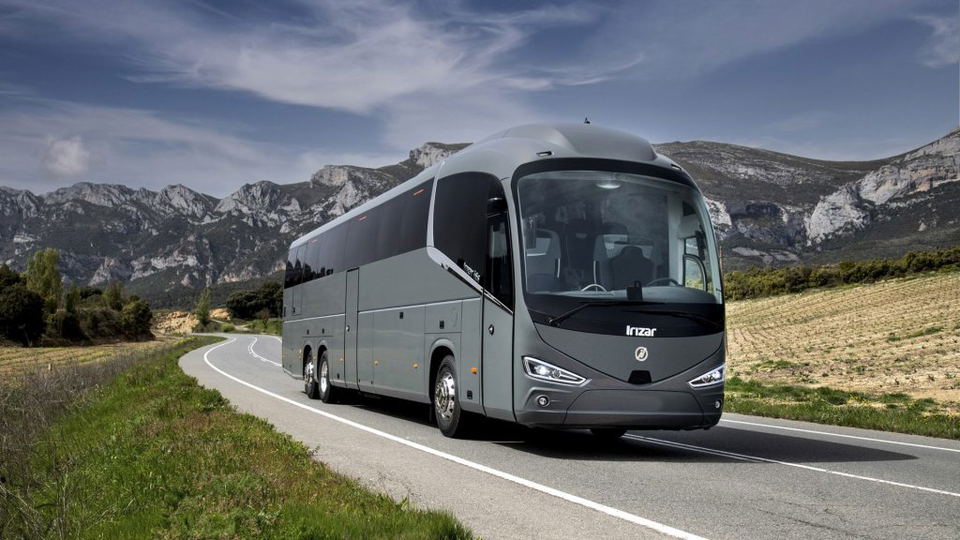
The earlier two-axle prototype presented in autumn 2023
The hydrogen-powered model will be available in four different lengths. The range will consist of two-axle versions measuring 12.2 and 12.9 metres, as well as three-axle versions measuring 14.07 and 14.98 metres. The two- and three-axle versions will have different hydrogen storage capacities, and the vehicles will be available not only with the 350-bar storage operating pressure currently most common in commercial road vehicles, but also with a 700-bar system. In the case of a 350-bar system, the hydrogen tanks of the two-axle variants can store a total of 46.3 kg of hydrogen gas, while the 700-bar version can store 57 kg. For the three-axle versions, these figures are 69.4 and 84 kg respectively.
The figures clearly show, however, that doubling the storage pressure does not in itself result in a proportional increase in range. In the case of the two-axle version, for example, the amount of hydrogen that can be stored on board rises from 46.3 to 57 kg when using a 700-bar operating pressure instead of 350 bar, which represents an increase of around 23%. The reason is that a 700-bar system does not by itself make it possible to store twice as much hydrogen as a 350-bar solution; in addition, the higher pressure requires more robust, thicker-walled tanks, which also take up part of the available space. In practice, this means that a vehicle offering a range of around 400 kilometres with a 350-bar system may be capable of covering not 800, but roughly 500 kilometres in 700-bar form.
The 700-bar system therefore does indeed offer a longer range, but the additional range available is far more modest than many might initially assume, while the higher-pressure infrastructure and operation typically involve additional costs. In heavy-duty vehicle applications, current thinking therefore suggests that the 350-bar system may remain the more competitive alternative, as it can be paired with simpler and cheaper refuelling infrastructure, while the range disadvantage may be smaller than expected.
Irizar’s new hydrogen bus is driven by a ZF CeTrax 2 central electric motor with a continuous output of 360 kW, integrated with an automatic three-speed gearbox. The fuel cell is housed in the former engine compartment, and its output has changed to 190 kW compared with the 200 kW unit used in the prototype presented in 2023. The driveline is complemented by a battery pack with a total capacity of 60 kWh, which, as an intermediate energy store, mainly provides assistance during acceleration under normal conditions and also plays a role in recovering braking energy. At low speeds, the energy supply is provided primarily by the fuel cell, with the batteries contributing only minimally to propulsion. At higher speeds, such as in motorway operation, the system’s operation is reversed: in this case, a significant portion of the required energy is supplied by the batteries, which are continuously charged by the fuel cell.
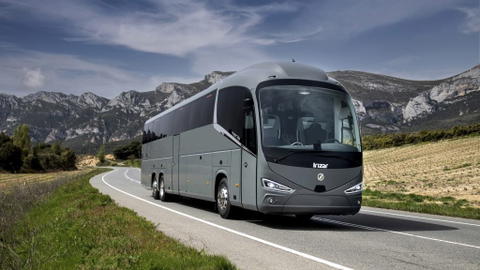
The cover image is an illustration.